What is the benefit of precision aluminum extrusion?
What is the benefit of precision aluminum extrusion?
Precision aluminum extrusion delivers exceptional dimensional accuracy, design flexibility, material efficiency, and performance, helping manufacturers reduce costs, enhance product quality, and optimize component design across a wide range of industries.
Precision aluminum extrusion is an advanced extrusion process in which heated aluminum alloy billets are forced through a precisely engineered die under high pressure to produce continuous profiles with exceptionally tight dimensional tolerances, consistent wall thicknesses, superior surface finishes, and uniform mechanical properties.
Compared with standard commercial extrusions, precision extrusion provides significantly tighter dimensional control—commonly achieving tolerances of ±0.1 mm or better on critical dimensions, with advanced processes capable of reaching tolerances as tight as ±0.02 mm.
It also offers improved straightness, reduced twist, and finer surface finishes, resulting in greater consistency and reliability.
This high level of process control maximizes aluminum’s inherent advantages while enabling the production of highly functional, near-net-shape components.
By minimizing secondary machining and finishing operations, precision aluminum extrusion can streamline manufacturing, reduce material waste, and improve overall production efficiency.
Inherent Material Advantages Amplified by Precision
Aluminum itself offers a strong starting point. It weighs about one-third as much as steel, iron, copper, or brass, which makes extrusions easier to handle, cheaper to ship, and well suited to weight-sensitive uses in transportation, aerospace, and moving assemblies.
By concentrating strength where it is needed through varied wall thicknesses and internal reinforcements—both of which are natural advantages of the extrusion process—manufacturers achieve an excellent strength-to-weight ratio.
Profiles can be designed to meet or surpass the performance requirements of many applications while still being much lighter.
Aluminum also gains strength at lower temperatures, which makes it useful in cold-weather and cryogenic applications.
Corrosion resistance is another key advantage.
Aluminum naturally develops a protective oxide layer that prevents rust.
This protection can be improved further with anodizing or other finishes.
The material is also noncombustible, nontoxic, non-magnetic, and non-sparking, which broadens its suitability for sensitive environments.
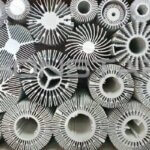
Its thermal conductivity is excellent when considered on a weight-and-cost basis, letting designers optimize heat dissipation through complex finned or multi-void profiles that would otherwise be difficult or costly to produce.
Electrical conductivity is strong as well—about twice that of copper on a pound-for-pound basis—making precision extrusions effective for bus bars, connectors, and related components.
Precision enhances these qualities.
Tight tolerances ensure that optimized cross-sections perform consistently: heat sinks maintain uniform thermal paths, structural members achieve reliable load distribution, and mating surfaces fit without excessive play or forced assembly.
Design Flexibility and Near-Net-Shape Capability
One of the most significant advantages is geometric freedom.
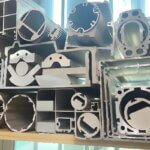
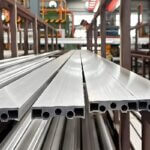
Extrusion can create solid, hollow, or multi-void profiles with complex internal features, undercuts, and varying thicknesses in a single piece.
Designers can position material precisely where structural, thermal, or functional requirements call for it, removing the need to assemble multiple components.
The resulting seamless profiles are generally stronger and more dependable than mechanically joined or welded assemblies, since they are less susceptible to leakage, loosening, or stress concentrations at joints.
Precision extrusion takes this capability even further into miniature and thin-wall designs.
Profiles can achieve very low unit weights—as little as a few grams per meter in specialized cases—while preserving structural integrity and tight geometric control.
This supports net-shape or near-net-shape production that closely matches the final part geometry, greatly reducing or eliminating costly machining, drilling, or secondary forming.
For instance, features that would otherwise require CNC operations after a standard extrusion can often be built directly into the precision die.
The process accommodates a broad range of alloys and tempers, enabling further adjustment of strength, formability, corrosion resistance, or conductivity.
Extrusion die tooling costs are relatively modest compared with many other custom metal-forming methods, and production lead times can be short once the die is proven.
Prototype costs are often manageable, which speeds up iteration and time to market.
Cost, Efficiency, and Manufacturing Benefits
Precision yields clear economic benefits. By maintaining tight tolerances from the die, manufacturers cut scrap, reduce rework, and decrease the amount of secondary machining required.
In many cases, parts go straight from extrusion—and perhaps cutting or light finishing—into assembly.
This shortens production cycles, improves inventory turns, and strengthens cash flow.
“Lights-out” or highly automated downstream processing also becomes more practical when incoming material is dimensionally consistent.
Material utilization improves because excess stock that would later be machined away is never extruded in the first place.
Assembly becomes faster and more reliable: precise fits reduce the need for shimming, force-fitting, or selective matching of components.
Consistent quality strengthens brand reputation and lowers warranty or return rates.
Overall manufacturing costs often fall even when the precision extrusion itself costs more than standard commercial material, because the savings in machining time, scrap, labor, and logistics outweigh the difference.
Production flexibility is high. Switching dies allows different profiles to run on the same press, supporting both high-volume runs and specialized smaller batches.
Complex assemblies can often be simplified into fewer extruded components, reducing assembly steps and potential failure points.
Performance, Reliability, and Application Advantages
In service, precision aluminum extrusions provide resilience.
Aluminum’s blend of strength and ductility lets it flex under load or absorb impact energy and spring back—an advantage in crash-management systems and dynamic structures.
Uniform properties along the length and across the cross-section support predictable performance and longer service life.
Applications span many sectors.
In aerospace and transportation, strength-to-weight benefits translate into fuel efficiency and payload gains.
Automotive and mobility systems use precision profiles for structural members, heat exchangers, and mounting systems.
Electronics and LED lighting rely on precision extrusions for thermal management and precise housing fits.
Medical devices benefit from biocompatible alloys, tight tolerances for instruments or housings, and cleanable surfaces.
Industrial equipment, architectural systems, firearms accessories (such as precision Picatinny rails produced to finished dimensions), and consumer products all take advantage of the ability to create optimized, lightweight, durable shapes.
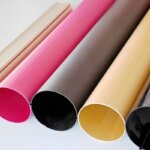
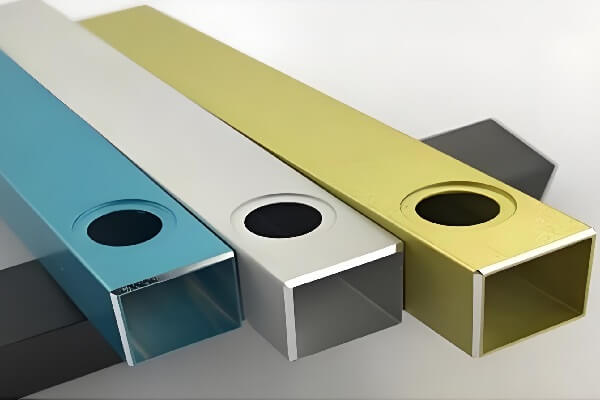
Surface quality from precision processes is typically superior, reducing the need for extensive finishing while enabling attractive anodized, painted, brushed, or polished appearances.
Straightness and low twist improve performance in linear motion systems, rails, and frames.
Sustainability and Lifecycle Benefits
Precision aluminum extrusion supports sustainable manufacturing by combining efficient material utilization, lightweight design, long service life, and aluminum’s strong recyclability.
Aluminum can be recycled repeatedly while retaining its fundamental properties, and producing recycled aluminum generally requires significantly less energy than producing primary aluminum.
The precision extrusion process further improves material efficiency by producing components close to their final dimensions.
By reducing excess material and minimizing scrap and secondary machining, manufacturers can lower resource consumption and improve overall production efficiency.
Lightweight precision-extruded components can also contribute to lower energy consumption during product use.
In automotive, transportation, and aerospace applications, reducing component weight can help improve fuel efficiency, extend operating range, or reduce overall energy requirements, depending on the application and system design.
Aluminum’s natural corrosion resistance can further extend component and product service life, reducing the need for frequent replacement and helping conserve materials over the product lifecycle.
Together, these characteristics make precision aluminum extrusion well suited to sustainable product design, green building initiatives, corporate sustainability programs, and circular-economy strategies.
By combining efficient manufacturing with lightweight, durable, and recyclable components, precision extrusion can help manufacturers pursue both performance and environmental objectives.
Practical Considerations and Overall Value
Achieving true precision aluminum extrusion requires more than simply tighter dimensional specifications.
High-quality extrusion dies—often manufactured from premium tool steels and enhanced with advanced coatings—play a critical role in achieving consistent results.
Modern die development may also incorporate simulation-driven design to optimize material flow, profile geometry, and dimensional stability before production begins.
Strict process control and appropriate inspection methods are equally important.
Maintaining tight tolerances requires careful control of billet temperature, extrusion speed, pressure, cooling, and other process variables, along with dimensional inspection throughout production.
Tighter tolerances naturally increase tooling and manufacturing costs, with the impact depending on the required level of precision, profile complexity, alloy, and production volume.
Not every application requires the tightest possible tolerances.
The most cost-effective approach is to specify precision according to actual functional requirements rather than pursuing tighter tolerances than the application demands.
For applications requiring accurate fits, complex geometries, lightweight construction, thermal management, or reduced secondary machining, the additional investment in precision extrusion can deliver significant manufacturing and performance benefits.
The Value of Precision Aluminum Extrusion
The advantages of precision aluminum extrusion come from the combination of aluminum’s inherent material properties and the extrusion process’s ability to produce highly accurate, complex, near-net-shape components.
For designers, precision extrusion provides greater freedom to optimize profiles for strength, weight, heat transfer, functionality, and assembly efficiency.
Complex features can often be integrated directly into the profile, reducing the need for multiple components and secondary manufacturing operations.
For manufacturers, precision extrusion can improve production efficiency through reduced machining, lower material waste, faster throughput, simplified assembly, and more streamlined supply chains.
Producing components closer to their final geometry can also improve material utilization and reduce overall manufacturing complexity.
For end users, the result can be lightweight, durable, corrosion-resistant, and high-performing components designed to deliver reliable service over extended operating lifecycles.
In many applications, the combination of material efficiency, simplified manufacturing, and reduced secondary processing can make precision-extruded components economically competitive with parts produced through more subtractive or multi-component manufacturing methods.
A Versatile Solution for Advanced Component Design
From aerospace and automotive to electronics, medical equipment, industrial machinery, architecture, and consumer products, precision aluminum extrusion provides a versatile manufacturing solution for demanding applications.
As extrusion technology continues to advance through improved die design, process simulation, automation, inspection systems, and alloy development, manufacturers can achieve increasingly sophisticated geometries and tighter levels of process control.
For companies seeking to balance performance, design flexibility, manufacturing efficiency, and total cost, precision aluminum extrusion offers a scalable approach to producing optimized components that meet both current and emerging engineering requirements.
You May Also Like
 How Aluminum Extrusion Enhances Product Design and Functionality
- Turn your design into aluminum extrusion parts
- What Issues Should Be Considered When Making Custom Aluminum Extrusion?
- Why Honstar Is Your Premier Choice for Custom Aluminum Extrusion
- Why Honstar Aluminum is the MVP of Custom Aluminum Profiles
- Enhance Your Custom Aluminum Extrusions with These Finishes